How it works
You ask. Hands go up. You pick.
Ask in five steps
Pick a kind, say what you need and when, choose who sees it. It fades from the map after two weeks.
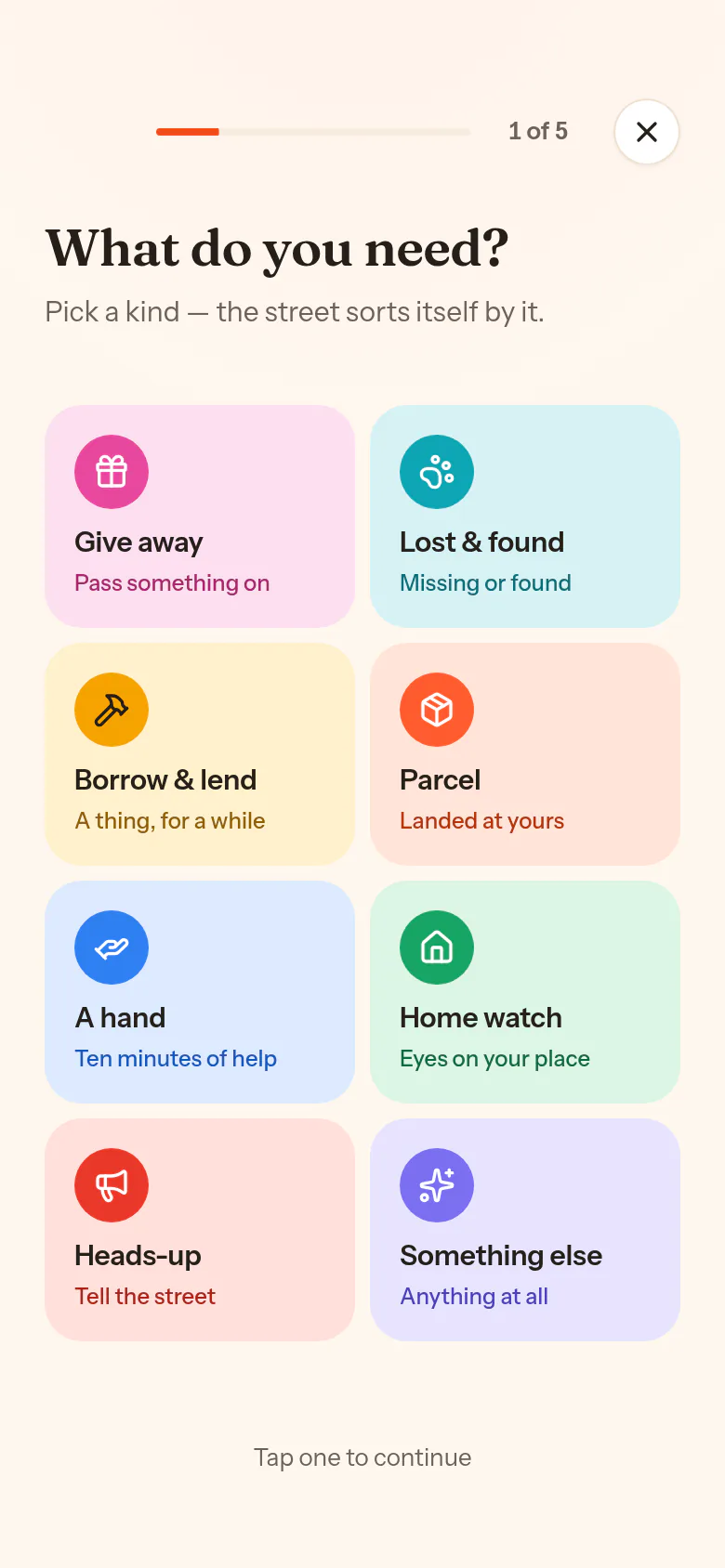
What do you need? Eight kinds, one tap each. Neighbors raise a hand
On their side, one button: I can help. You see the hands in the order they went up, and nobody but you sees who has a hand up.
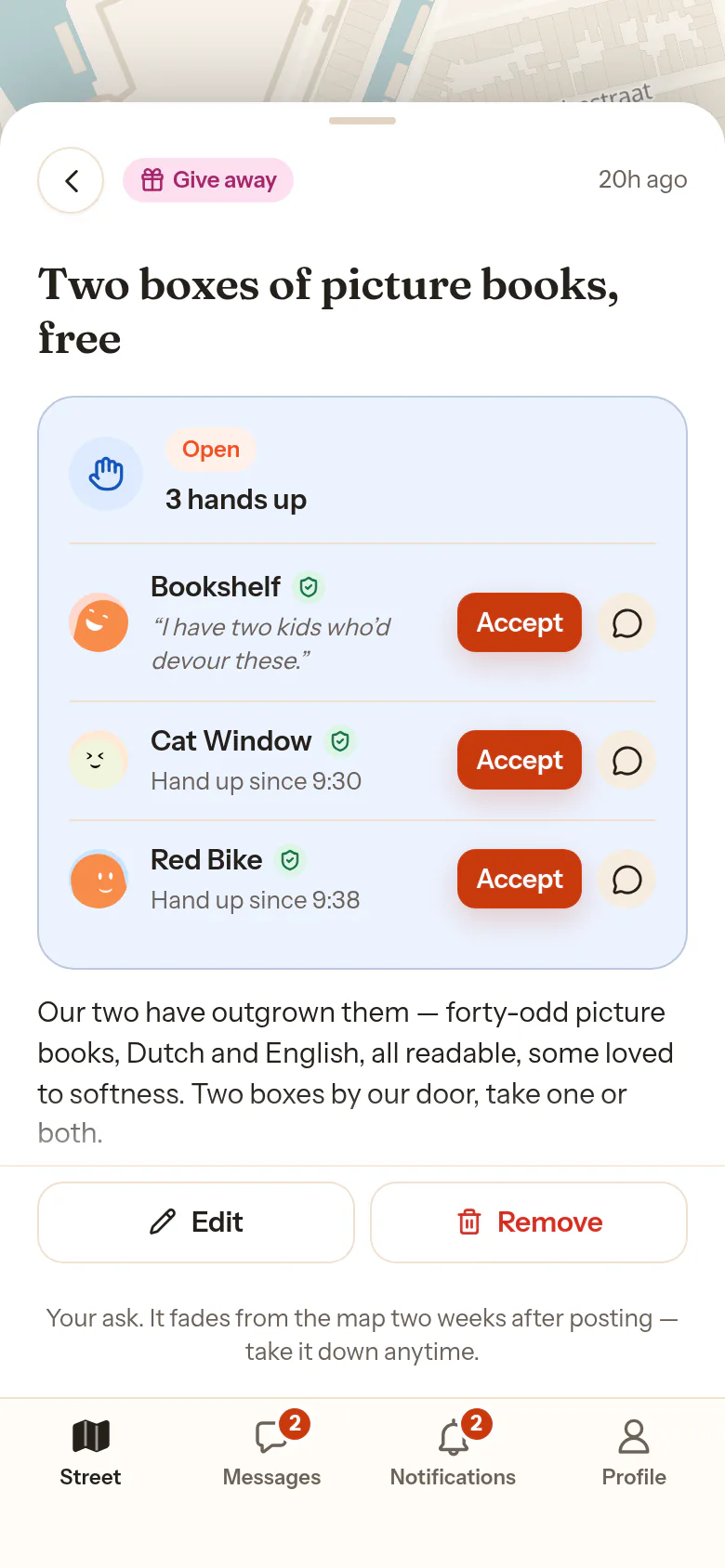
Your ask: three hands up, one Accept per hand. You pick. It gets done.
Accept one hand or several. When they say it is sorted, you confirm, and each helper earns one kudos. No stars, no ratings, no ranking: a kudos is one thank-you, counted in the open.
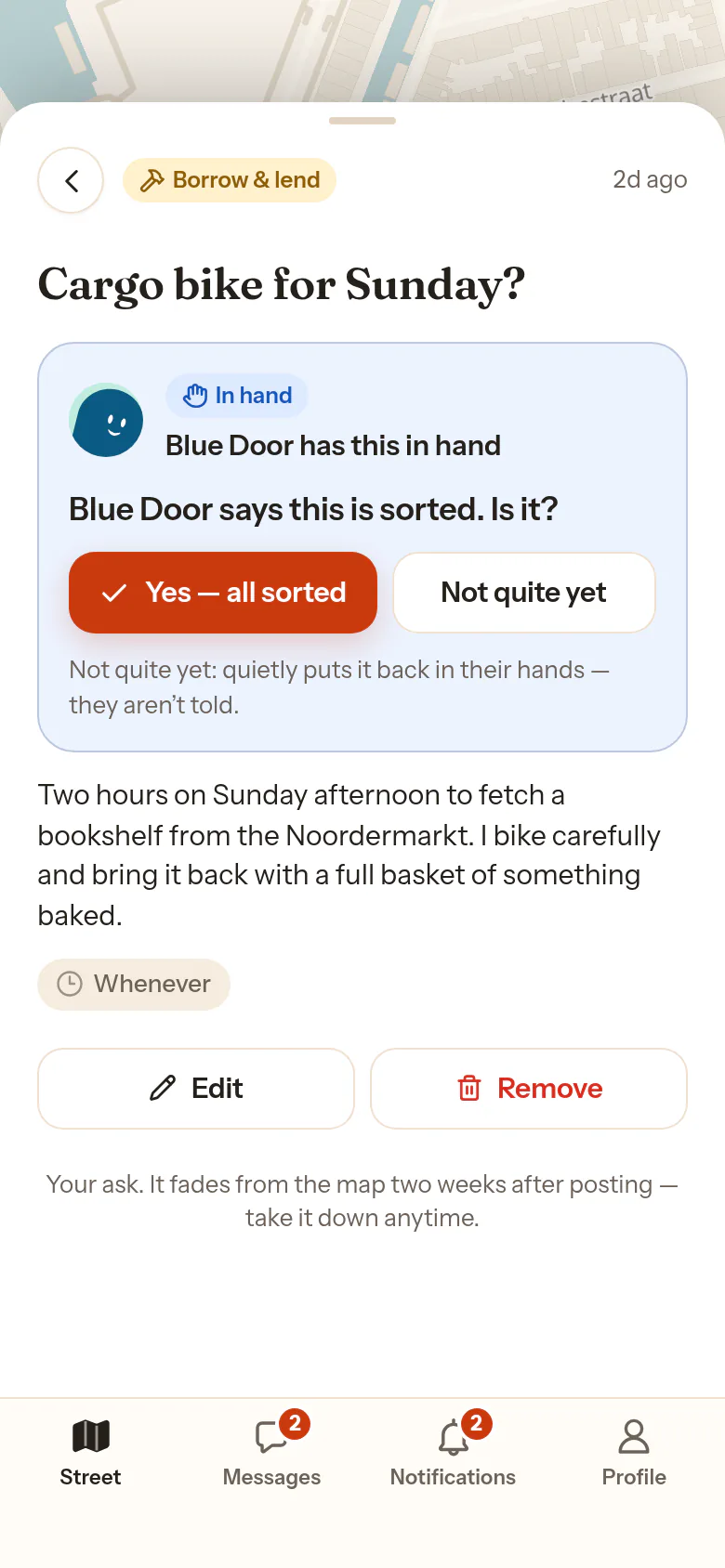
Blue Door says this is sorted. Is it? You decide.


The tour, from the helper’s seat to the asker’s: 44 seconds, silent, with captions in English.
Read what the tour says
- Your street at a glance: every open ask, a few doors away.
- Tap an ask to read it.
- One button. The asker picks who helps.
- Your hand is up. Nobody else is told.
- Changed your mind? Undo. Nobody was told.
- Hand up for real this time.
- Your own ask: two neighbors raised a hand.
- You pick. One tap per hand.
- Accepted. Eight seconds to undo, then it’s settled.
- Talk it over. No real names unless you choose to.
- Your first name, in this conversation only. Or never.
- Sorted? Mark it done.
- Someone else’s parcel? Pick the neighbor, add a note. No phone numbers change hands.
- Quiet hours you set once. Off means off.
- And your own hand? They said yes.
- No real names. No ads. No feed.
A demo street with made-up neighbors.
Two moments we all know
You have neighbors. Reaching them is the hard part.
A courier left someone else’s parcel with you
Number 47 is somewhere on your street. Pick the neighbor on the map, add a note, tap Let them know: it starts a conversation in their Messages, and no phone numbers change hands.

Away two weeks. Who looks in on your place?
Post a home-watch ask with your dates. A neighbor taps I’ll keep an eye out, you accept, and only the neighbor you accepted gets the check-in button; the reports land in your conversation, wherever you are. Your away dates stay hidden from anyone unverified.

Most of us would gladly help a neighbor. Few of us dare to ask. Kylala makes the asking small.
Is it for you?
For you, and free in both directions.
For you if
- you would lend a ladder but would rather not join another group chat
- you go away and would like someone to look in on your place
- a courier keeps leaving other people’s parcels with you
- you can fix a bike or water plants and would like to say so without becoming a business
- you want your nights quiet
What never costs anything
- asking for a hand, and helping: free in both directions
- replying: no response quota, no premium queue, every hand can go up
- being found: no pro badges, no paid placement, no ratings to buy
- staying: no subscription exists, so there is nothing to cancel
- your attention: no ads, it is not the product
Private by construction
We cannot sell what we never stored.
No real names.
A nickname and a generated face, no real-name field. Your first name is shared in one conversation, or never.
No ads, no trackers, no data sales.
No analytics, no cookies, here or in the app. Your email and phone number have no column to live in.
Your address, on your screen only.
Checked against OpenStreetMap when you join, shown to nobody else, ever. Your pin: exact, or blurred about 50 m.
No feed to scroll.
A map of open asks, the list under it. Nothing ranked for engagement, asks fade after 14 days, no crime alerts.
Also refused, on purpose: phone numbers between neighbors, prices, ratings, pro badges, a paywall on helping, and pings you did not ask for.


Calm, with numbers
Nothing rings unless someone is waiting on you, or you asked to be told.
Notifications is a tab, not a firehose: one row per story, read where you tap it. More
What happened always shows in Notifications; one switch decides what rings, and off means off. Quiet hours are a nightly window you set once.


- 14 daysasks fade from the map
- 30 daysnotification rows fade
- 90 quiet daysoffers sleep until you wake them
- 2 a dayinterest alerts, at most
- 10 secondsbefore a raised hand rings anyone
- 8 secondsto undo an accept
- 1 switchoff means off
And the rest
Everything else a street needs, without the noise.
Your offers, and Hands nearby.
Up to three offers on your card, in your own words; neighbors find them a few doors down. The field guide
Circles.
A private room for one building: a steward opens it, neighbors knock or bring a code, one message reaches everyone. The group-chat guide
Announcements.
Verified neighbors reach a circle or hand-picked neighbors, vouched-for neighbors a whole radius; it lands in Notifications, and replies become conversations.
Gentle verification.
Nothing to upload, ever.
More
Being around home on three different days verifies you, unless your street’s keeper has verified everyone by default. A code from a vouched neighbor, a vouched steward or the street keeper vouches for you; only that opens announcements to a radius and the away dates on home-watch asks.Blocks, reports and appeals.
Block from any ask or conversation, silently; reports go to a human; a banned account loses the street.
One account, every device.
Link a laptop with a ten-minute code; see your devices, remove one.
More
Light, dark or auto; five languages; installs from the browser, no app store.

Behind the map
Kylala is independent: no advertiser, no data buyer and no parent company behind it. The three promises it holds as constraints, what is live and how to partner are on the About page.
Fair questions
What is Kylala?
Kylala is a free, private neighborhood app: a live map of your street where neighbors ask for a hand and raise one. No real names, no phone numbers, no ads.
Who sees my ask?
You choose, ask by ask: everyone on the map, the neighbors within a radius you set around your pin, or one of your circles. It appears as a pin on their map and in the list under it, opens a conversation, and fades after two weeks. Only you see who raised a hand until you accept one.
How do I get my street on Kylala?
Join, then bring the next neighbor: print the A5 flyer for the letterboxes, or start a circle for your building and hand out its code. Circles are drawn from OpenStreetMap wherever people show up, so there is nothing to apply for and no waiting list.
More questions
Does Kylala work for one building or a residence?
Yes, that is its smallest unit: a circle is one building or one block with a steward at the door. Neighbors come in with a code or by knocking, share one room, pass parcels to the right door and reach everyone in one message. No syndic paperwork, no fees; see the page for buildings.
How do I invite my neighbors?
Open kylala.com/invite/: an A4 poster and door cards to print, cards and a message to send on WhatsApp or any chat, and a link that carries your circle’s code so a neighbor lands in your circle after signing up. Stewards find that link in the app under Invite neighbors.
Is Kylala free?
Yes, in both directions: asking is free and helping is free. No response quotas, no premium queue, no subscription exists, so there is nothing to cancel. No ads, no data sales.
What is the catch?
There is none we hide. Kylala is free in both directions and stays so: if it ever costs money at scale, that will be optional supporter contributions, never a paywall on helping, never ads, never your data. The one trade you make: you give an address, shown to nobody, so the map stays a map of real homes.
Is Kylala anonymous?
You appear as a nickname, like “Warm Bread” or just your house number, with a generated face. The profile has no field for a real name; you can share your first name inside one conversation, or never. Your address is shown to nobody, no email or phone number is kept, and your pin can be blurred about 50 m.
Why does Kylala ask for my address?
So the map stays a map of real homes: your address is checked against OpenStreetMap when you join and kept as you typed it if the map does not know it yet. It is returned only to you and shown to nobody else. Your map pin is a separate thing, placed exactly or blurred about 50 m, your choice.
What happens to my data?
The minimum, in Kylala’s database: a nickname, two numbers for your face, your pin, your address (shown only to you), what you post, and the bookkeeping the privacy policy lists: a hashed device key, a grid-snapped check-in point, your push endpoint when push is on. No email, phone number or tracker, anywhere. Deleting your account is immediate and real.
Do neighbors see my email or phone number?
Never. Neighbors see a nickname and a generated face; no phone number is needed, and your email is shown to nobody. It is not kept on Kylala’s servers either: what we keep from a Google or email sign-in is one opaque account id from the provider, and nothing else.
What if I lose my phone?
Link a second device beforehand with a one-time code from your Profile, or keep the recovery key Kylala hands you whenever you sign out: it reopens the account on any device. Remove a lost device from the Devices list and it is signed out at its next call.
Does Kylala work on iPhone?
Yes: Kylala is a web app that runs in Safari on iPhone, Chrome on Android and any modern desktop browser. On iPhone, Share, then Add to Home Screen gives it a full screen, an icon and notifications; the light or dark theme follows your phone.
Is Kylala on the App Store or Google Play?
No, on purpose: it installs from the browser, so there is no store account and no review queue between a fix and your phone. Add to Home Screen on iPhone, Install app on Android, the address-bar icon on a desktop. Everything works in a browser tab too.
What can I ask my neighbors for?
Eight kinds of asks: give something away, lost and found, borrow or lend, a misdelivered parcel, a hand for ten minutes, home watch while you are away, a heads-up for the street, or something else with your own label. Each lands as a pin on the map and opens a conversation.
How do I help a neighbor?
Tap an ask and raise your hand; the asker picks one or several helpers, and you can take your hand back anytime. Beyond asks, put up to three standing offers on your card, in your Profile (bike repair, a ladder to lend), so Hands nearby shows them to the street. Helping is free, never rated, never rationed.
Is Kylala safe?
As safe as its design can make it: nobody sees your real name or address, conversations start from an ask or a request you can ignore, and you can block anyone from any ask or conversation, silently. Reports go to a human; there is an appeal. A neighbor is still a stranger: the guides say how to keep it easy.
How is Kylala different from Nextdoor or a WhatsApp group?
No real names, no addresses shown, no crime-and-fear category, no ranked feed, no ads. In a group chat a message scrolls away and every member can usually see your number; here an ask is a pin that fades after two weeks, and nobody gets your number. A tool you open when you need a neighbor, not a place to scroll.
Why not just a WhatsApp group for the building?
A group works until it doesn’t: your number handed to thirty people, no radius, nothing expires, one exhausted admin. Kylala keeps the conversation and adds what a group lacks: nicknames instead of numbers, a steward who lets people in, asks that fade after two weeks, and quiet hours you set yourself.
What if someone misbehaves?
Block a neighbor from any ask or conversation: their asks leave your street, chat goes quiet both ways, and they are not told. Reports go to a human; content can be taken down, a repeat offender banned, and there is an appeal if we get it wrong. A banned account loses the street.
Which cities is Kylala available in?
Any street, anywhere: Kylala is not rolled out city by city. Your pin goes on the map the moment you confirm your address, and building circles are drawn from OpenStreetMap wherever people show up. It speaks English, French, German, Spanish and Italian.
Who is behind Kylala?
Kylala is independent: no advertiser, no data buyer and no parent company behind it. Three promises bind it, in writing: free in both directions, privacy that holds, honesty as a habit. The About page says what is live and how to partner, invest or reach us.